What happens to excess skin after weight loss?
What causes loose skin?
Skin becoming loose after weight loss is down to the fact that the skin's collagen and elastin – the substances that give skin its elasticity and firmness – do not always recover fully. Several factors have an effect:
- Reduced production of collagen and elastin. When the skin has been stretched for a long time, for example by being overweight, it finds it harder to contract again – particularly with increasing age.
- How much weight you lose. The more weight you lose, the greater the risk that the skin will not keep up. With a weight loss of 5–10 kilos the skin can usually adapt, but with a larger weight loss (20–25 kilos or more) excess skin can remain.
- How quickly you lose the weight. Rapid weight loss does not give the skin enough time to adapt. A slower, more controlled weight loss gives the skin better conditions in which to contract.
- Age. The skin's production of collagen and elastin decreases with age, which means elasticity naturally deteriorates.
- Genetics and skin quality. Every body reacts differently. Some people genetically have better skin elasticity, or habits that promote skin health, which means the skin recovers more easily.
When excess skin causes problems
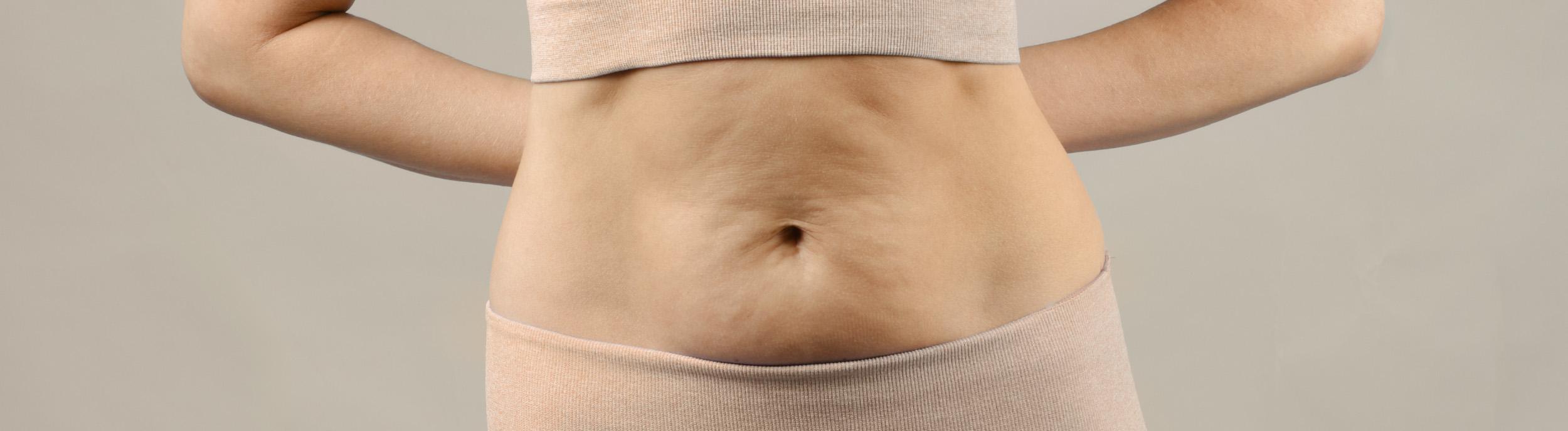
Excess skin is not only an aesthetic question – it can also lead to physical complaints. When large folds of skin fold over one another, moisture can collect and cause skin irritation, rashes or infections. For some people it also becomes difficult to move or exercise, because the skin is heavy and in the way.
Physical and psychological complaints
• Skin irritation or rashes. Moisture and sweat can become trapped in folds of skin and lead to rashes, chafing or fungal infections.
• Physical discomfort. Heavy skin hanging around the stomach, thighs and arms can make certain movements particularly uncomfortable.
• Reduced mobility. Loose skin around the thighs, arms or stomach can limit your freedom of movement and make it harder to exercise and stay active.
• Difficulty maintaining good hygiene. It can be difficult to keep clean when the skin folds, which can cause odour in the skin folds or certain hygiene problems.
• Reduced self-confidence. Many people find that loose skin affects their self-confidence, particularly when it shows in clothes or swimwear.
Getting rid of excess skin
If loose skin causes discomfort or affects your self-esteem, there are above all three ways of dealing with it.
- Lifestyle changes. Strength training, a balanced diet and good hydration give the skin better firmness. Making lifestyle changes to get rid of the excess is most effective with mild to moderate amounts of loose skin.
- Non-surgical treatments. IPL, ultrasound skin tightening and chemical peels are three non-surgical treatments that can stimulate collagen production and make the skin firmer. These treatments are a good fit if you have a mild to moderate amount of loose skin.
- Surgical procedure. With larger amounts of excess skin, surgery is often the most effective option. Procedures such as a tummy tuck, an arm lift and a thigh lift remove the excess skin and give a firmer appearance. Afterwards it takes several months before you are fully recovered, but the result is long-lasting.
If you are unsure which option suits you, it can be a good idea to book a consultation to get an assessment of your skin and the possible treatment options.
Get rid of loose skin with Adoreal
Are you having problems with loose skin after weight loss? Adoreal is here to guide you. Take the next step towards the body you want and create an account or log in to get access to expert advice, compare treatments and find clinics you can trust.
Ready to talk to someone who treats this every day?
Find a Provider