
Skin tightening · Renuvion
Surgical skin tightening: Compare practices from our network
Renuvion tightens loose skin from beneath, using helium plasma and radiofrequency energy delivered through small entry points. It is often performed alongside liposuction.
Our network
Surgical skin tightening providers from Adoreal's partner network.

Irvine, California · United States
South Coast Plastic Surgery (SoCo)
Renuvion skin tightening through small entry points, on its own or paired with liposuction, on the abdomen, arms, thighs and neck.
Irvine, California · United States
South Coast Plastic Surgery (SoCo)
Renuvion skin tightening through small entry points, on its own or paired with liposuction, on the abdomen, arms, thighs and neck.
Ready to see who performs surgical skin tightening near you?
Compare ProvidersDecision support
How to choose a surgeon for skin tightening
Board certification is the starting point. The details below are worth weighing carefully when you're choosing the surgeon who's right for your goals.
Here's what to look for before you decide:
First, tightening or skin removal?
Renuvion suits mild to moderate laxity. Where skin is very loose after major weight loss or pregnancy, a procedure that removes skin usually does more. A surgeon who tells you which side of that line you are on is being honest with you.
Ask which device, and for which use.
The FDA advises patients to ask which device their provider will use and to discuss the benefits and risks. Renuvion is cleared for specific uses, including after liposuction for body contouring and for loose skin of the neck. Ask how your planned treatment fits.
Ask how they protect against burns.
The energy works beneath the skin, and burns are a recognized risk. A practice that can explain its energy settings, technique and temperature monitoring is taking that risk seriously.
Know the setting and anesthesia.
Depending on the area and whether liposuction is combined, treatment may use local anesthesia with sedation or a general anesthetic. Ask where it is done, who monitors you, and what that means for your recovery.
Expect a gradual result, explained honestly.
Some tightening shows early, but improvement builds over six to twelve months as collagen forms. A surgeon who sets that expectation clearly, without promising a surgical-lift result, is one you can trust.
Before your consultation, prepare this question
“Is my skin a candidate for tightening, or would removing skin do more for me, and which device would you use?”
A surgeon who answers both parts plainly, including when tightening is not enough, is planning around you, not around a device.
Find a Surgical Skin Tightening ProviderAbout the treatment
About surgical skin tightening
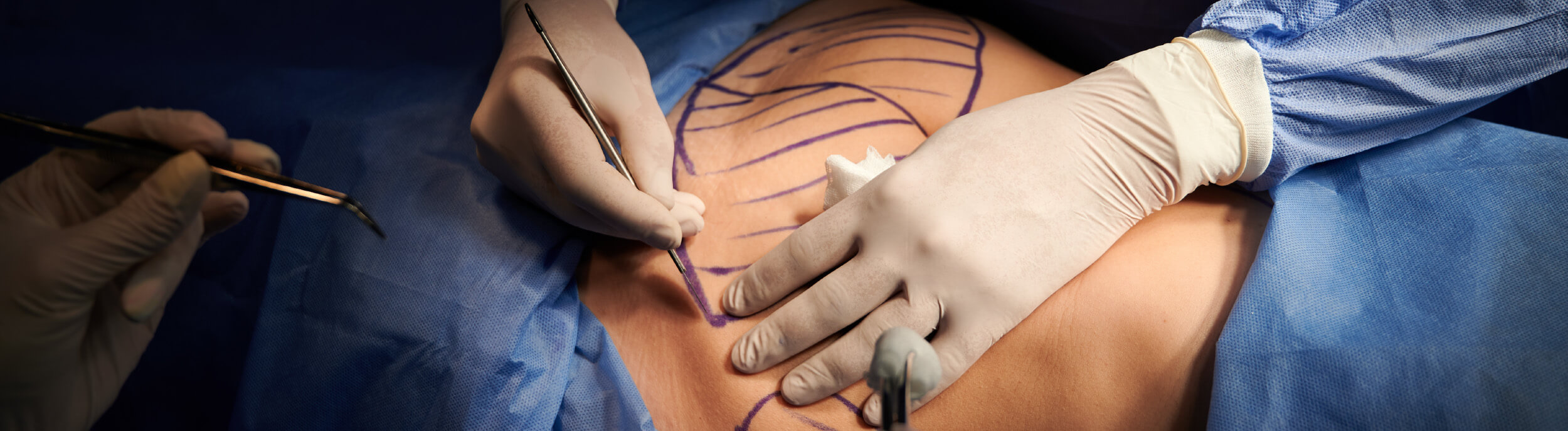
Surgical skin tightening with Renuvion treats loose skin from underneath. A slender cannula is passed beneath the skin through small entry points of around three to four millimeters and delivers helium plasma energized by radiofrequency. The heat contracts the tissue beneath the skin and stimulates new collagen, so the skin tightens over the following months.
It is most often paired with liposuction. Liposuction removes fat but cannot tighten the skin over it; Renuvion is used, often through the same incisions, to help the skin contract to the slimmer shape. It can also be performed on its own.
Renuvion was earlier known as J-Plasma. In the United States, the FDA has cleared it for specific uses, including treating tissue beneath the skin after liposuction for body contouring, and improving loose skin of the neck and under the chin.
Commonly treated areas
- Abdomen, waist and flanks, often together with liposuction.
- Upper arms, for crepey or loose skin.
- Thighs and knees, where skin has lost some firmness.
- Neck and under the chin, for mild to moderate laxity.
What is surgical skin tightening?
Renuvion tightens loose skin from beneath, using helium plasma and radiofrequency energy delivered through a cannula and small entry points.
It is often combined with liposuction, and suits mild to moderate laxity.
How it is used
Your surgeon plans the treatment around your skin and goals:
With liposuction, to help the skin contract after fat is removed.
On its own, for mild to moderate laxity.
Body areas, such as the abdomen, arms, thighs and knees.
Neck and under the chin, for loose skin.
Are you a candidate?
Your surgeon will usually want you to be:
Bothered by mild to moderate loose or crepey skin
In good general health
A non-smoker
Realistic that results are gradual and more modest than surgical skin removal
The treatment, step by step
01. Consultation and assessment. Skin quality and laxity assessed; tightening compared with skin removal.
02. Preparation. Instructions on medication and smoking; anesthesia agreed.
03. Anesthesia. Local with sedation, or general anesthesia.
04. Liposuction. If planned, fat is removed first.
05. Tightening. Helium plasma and radiofrequency energy delivered beneath the skin.
06. Closing and support. Small incisions dressed and compression applied.
Recovery and aftercare
Swelling, bruising and discomfort settle over the first weeks.
Non-strenuous daily activities within about two to seven days
Compression for one to four weeks
Avoid strenuous activity until cleared
Longer recovery when combined with liposuction
Improvement continues for six to twelve months.
Risks and side effects
Complications are uncommon, but include:
Burns, heat injury to the skin.
Seroma, fluid under the treated skin.
Contour irregularities, particularly with liposuction.
Temporary numbness in the treated area.
Infection, uncommon, at the entry points.
When to seek medical attention
- Blistering, darkening or an open area on the treated skin
- Fever, or spreading redness, warmth, or discharge from an entry point
- Sudden or one-sided swelling
- Severe pain not controlled by prescribed medication
- Shortness of breath or chest pain, which need emergency care
Contact your surgeon's practice directly, or seek emergency care, if you experience any of the above.
Common questions
Surgical skin tightening questions, answered.
If your question isn't here, ask us directly. A real person answers, and we won't push you toward anything.
Talk to us →Is Renuvion surgery?
It is minimally invasive rather than a traditional operation: there are no long incisions and no skin is removed. But it is performed beneath the skin through small entry points, often under sedation or general anesthesia and alongside liposuction, so it is planned and done by a surgeon.
How is it different from a tummy tuck or arm lift?
Those procedures remove loose skin and leave longer scars. Renuvion tightens skin from beneath without removing it, so it suits milder laxity. Where skin is very loose, surgical removal usually gives a bigger change.
Is Renuvion the same as J-Plasma?
Yes. J-Plasma is an earlier name for the same helium-plasma technology, now marketed as Renuvion.
Is Renuvion FDA cleared?
For specific uses. The FDA has cleared it for treating tissue beneath the skin after liposuction for body contouring, and for improving loose skin of the neck and under the chin. The FDA advises patients to ask which device will be used and to discuss its benefits and risks.
Why combine it with liposuction?
Liposuction removes fat but cannot tighten the skin. Renuvion is used, often through the same incisions, to help the skin contract to the slimmer shape and reduce the risk of loose skin afterwards.
How many treatments will I need?
Most patients need a single treatment. Aging continues, so some choose further treatment years later.
When will I see results?
Some tightening is often visible early, but swelling hides it at first. Improvement continues for roughly six to twelve months as new collagen forms.
How long is the recovery?
Most people return to non-strenuous daily activities within two to seven days, and desk work within three to five days. Compression is worn for one to four weeks. Recovery is longer when liposuction is combined.
What are the main risks?
Uncommon risks include burns, fluid collection, contour irregularities, temporary numbness and infection. Ask your surgeon how they set the energy and monitor temperature to protect the skin.
Is it covered by insurance?
Generally not, as it is considered a cosmetic procedure. Ask the practice what the quoted fee includes.

Related treatments

Liposuction
Removes localized fat to reshape an area.

Excess skin removal
For skin laxity that liposuction alone cannot address.

Tummy tuck
Removes excess abdominal skin and tightens muscle.

Neck lift
Restores definition to the neck and jawline.

Body sculpting and contouring
Surgical and non-surgical reshaping options.
More on surgical skin tightening.
Article
How long does it take to recover from liposuction?
We look at the factors that can influence recovery time and what you can expect during the healing process.
Article
What is the best body sculpting treatment?
The best treatment for you will depend on factors such as the amount of fat you want to remove, your tolerance for downtime, and your desired results.